
A small kitchen does not need more cabinets. It needs a plan for the cabinets that are already there. Most small kitchens feel chaotic because everything is put in the empty spot so nothing has a real home. Cooking takes longer counters get lost under clutter. Buying a second spatula feels easier than finding the first one.
This guide fixes that with small kitchen organization ideas that work in kitchens even in rentals. No remodel, no new cabinets and nothing that costs more than about fifteen dollars unless it is a bigger buy. Work through the sections in order because each one makes the next one easier.
Start With Zones, Not Containers
The biggest mistake in a kitchen is organizing by container instead of by task. A set of matching bins looks tidy on day one. Fails by week two because the bins do not match how you actually cook. Zones do.
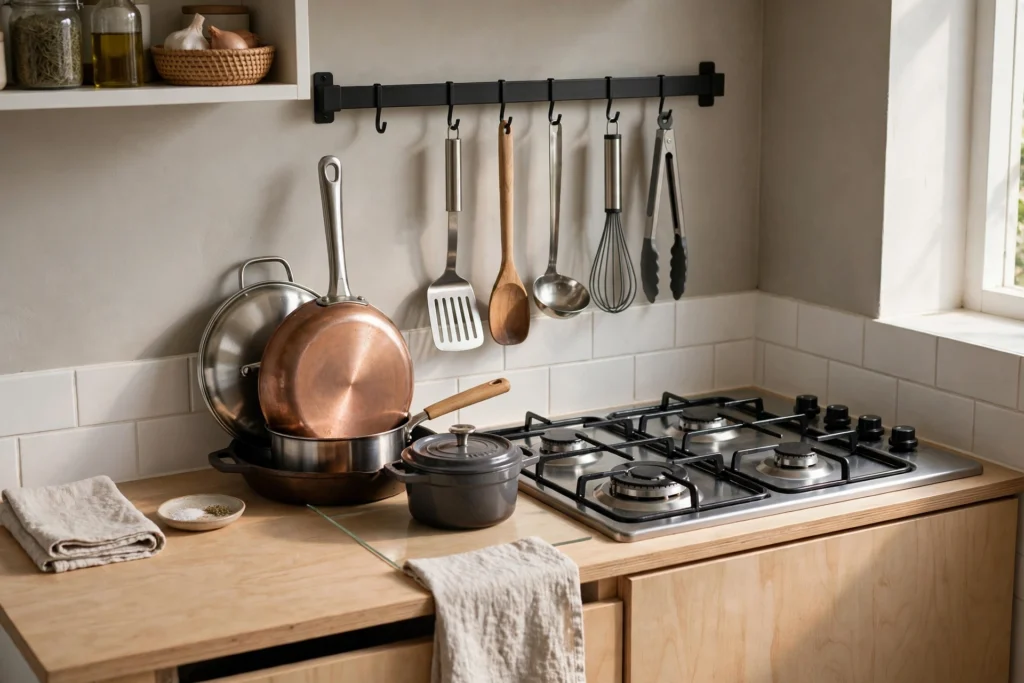
Divide a kitchen into four zones: prep, cook, clean and store. Prep lives near the cutting board and knives. Cook lives near the stove and the pots. Clean lives near the sink and the dishwasher. Store lives in the pantry and the fridge. Now walk to each zone and ask one question: is everything I need for this job within one step? If your spatulas live across the kitchen from the stove that is a daily annoyance that you can fix in ten minutes.
Move things before buying anything. Put plates near the dishwasher so unloading takes two minutes. Put spices near the stove if you season while you cook or near the prep area if you measure everything first. Put coffee items together in one spot even if that spot is one shelf and a small tray. Our welcome decor guide shows the idea at the front door, where giving everything a home keeps a small space calm: https://mycozyhomestyle.com/2026/09/25/welcome-decor-for-home-easy-ideas-to-make-your-entryway-feel-warm-and-inviting/
The zone test is simple. Cook one dinner after the move. Every time you cross the kitchen for something that item belongs in the zone where you were standing. After three dinners the layout will mostly be right.
Use the Walls Before You Buy Anything
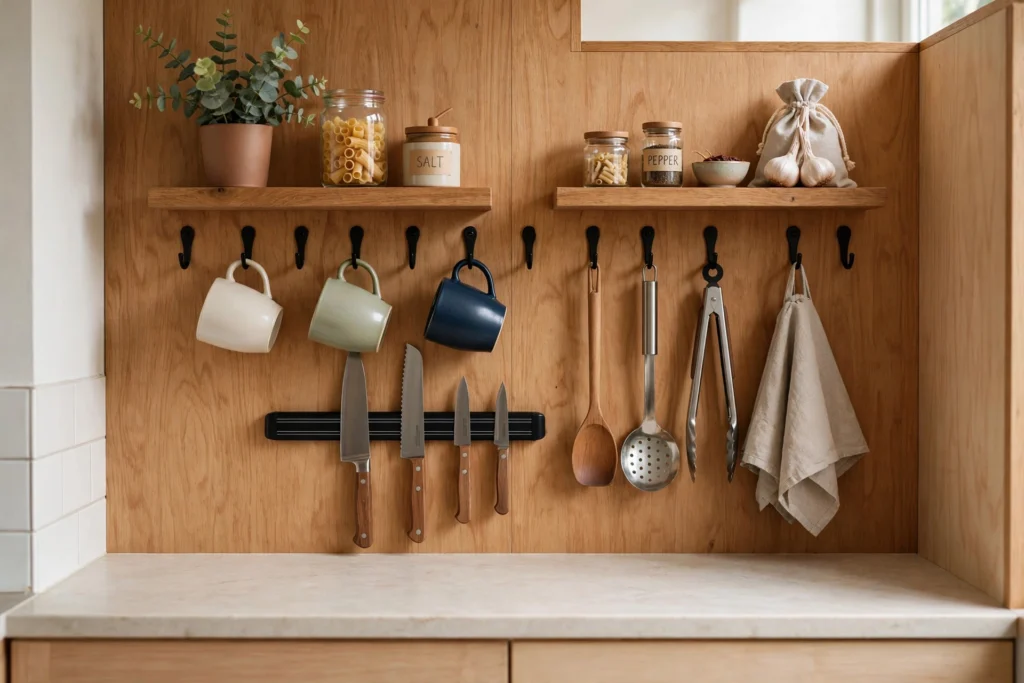
In a kitchen the walls are free storage. Counters are not. Every item you move from a counter to a wall makes the kitchen feel bigger and makes cooking easier.
Start with the inside of cabinet doors. A five dollar rack on the inside of a door holds measuring cups, spices or cleaning spray without taking an inch of shelf space. Next look at the wall beside the stove. A magnetic strip holds knives safely and frees a whole drawer. A simple rail with hooks holds the spatulas, ladles and tongs you reach for every day right where you use them.
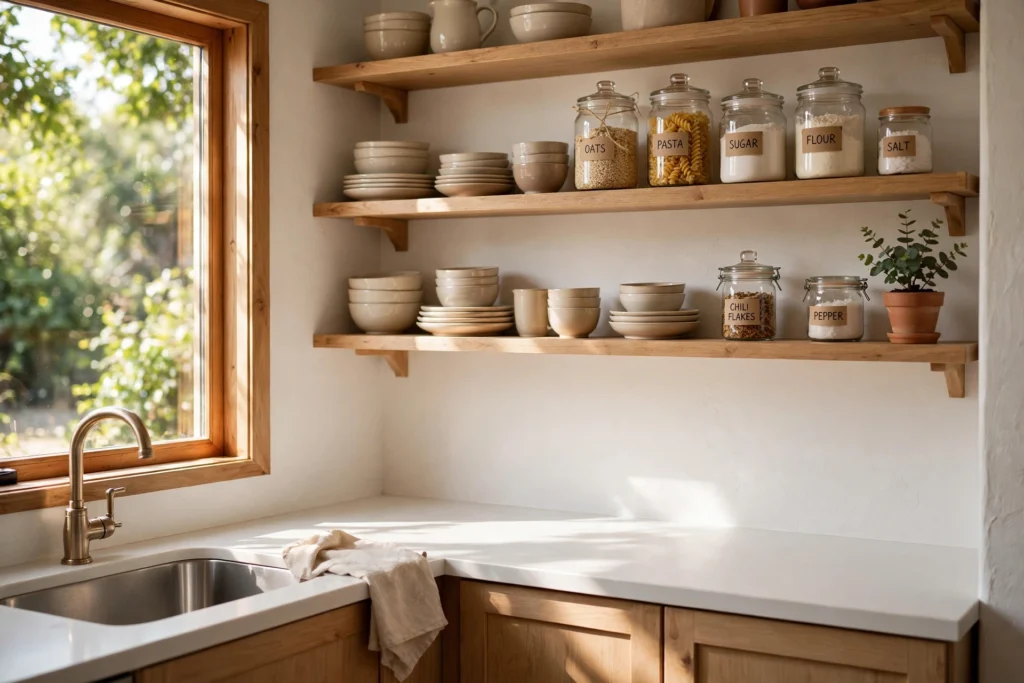
Open shelving works in a kitchen only when it is edited hard. One shelf with six bowls and a plant looks calm. Three shelves packed with everything you own looks like clutter, at eye level. If you add a shelf give it one job: dishes or mugs or the oils and vinegars you actually use. The rest stays behind closed doors.
The same small space thinking runs through our small space fall decor ideas, where a few chosen pieces beat a crowded display: https://mycozyhomestyle.com/2026/10/24/small-space-fall-decor-ideas/
Fix the Drawers
Drawers fail because they are too deep and too empty at the same time. A junk drawer is a drawer with no dividers. Fixing it costs almost nothing and changes how the kitchen feels every single day.
Kitchen drawer organization ideas start with one rule: every drawer gets one job. The cooking drawer holds spatulas, tongs and ladles. The cutlery drawer holds forks, knives and spoons. The tool drawer holds the peeler, the thermometer and the scissors. When a drawer has one job you stop digging.
Use dividers that fit the drawer, not the other way around. Cheap bamboo or plastic dividers cost about 8 to 12 dollars. Can be cut or adjusted. Measure the drawer first then buy. Put the used tools at the front and the rarely used ones at the back. If a drawer still will not close something in it belongs somewhere else, usually in a zone you have not set up yet.
One drawer deserves attention: the drawer under the stove or beside it. This is where baking sheets, cutting boards and trays usually end up in a stuck pile. Stand them upright with a vertical divider, like books, on a shelf. You will grab the right one first time every time and the pile will never jam again.
Tame the Pantry
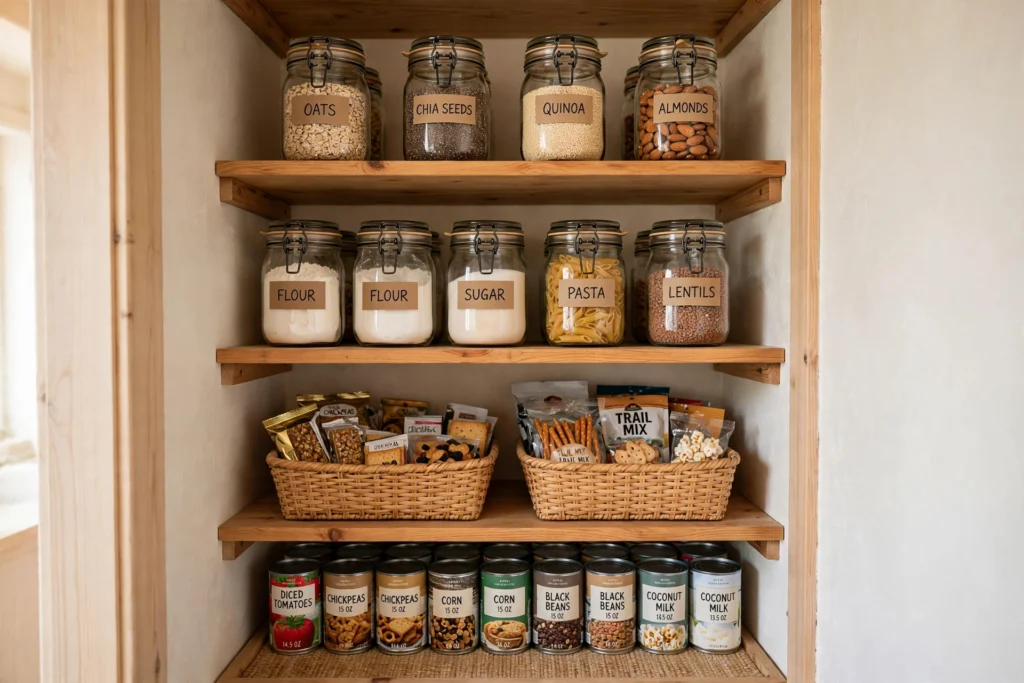
A pantry is not a storage room. A pantry is a small shop, and a pantry needs the same logic: what you use most should be at eye level, what you use least should be high or low, and nothing should go into a pantry without a label or a clear container that you can see into. For a seasonal take on the same pantry logic, see our fall pantry organization ideas for a small kitchen.
Start by taking everything out of the pantry. Throw away anything that is expired or that you know you will never use. Group the items that remain: grains, cans, baking supplies, snacks, sauces. Put each group in its spot and put the group that you reach for daily at eye level. A lazy Susan, about 10 dollars, fixes the deep corner shelf where cans like to hide. A clear bin for snacks stops the slide into a pile of half open bags.
Decant the items that make sense. Flour, sugar, rice and oats are worth putting into jars because you can see when they run low and they pour cleanly. Cereal and crackers are not because the box already pours fine and the bag keeps them fresh. Do not decant everything at once. Pick four staples do those and stop.
Write the date on anything that you open. A small piece of tape and a marker takes three seconds. Ends the mystery jar problem forever. When you shop, check the pantry before you leave, not in the store aisle. Most duplicate purchases happen because nobody could see what was already home.
Keep the Counters Clear
Clear counters are not a style choice in a kitchen. They are the workspace. If your counters are full you have nowhere to cook so cooking feels like a chore and takeout wins.
Pick three things that are allowed to live on the counter. A good default set is the knife block, the coffee maker and one tray with the oils and salt. Everything else gets a home in a cabinet, a drawer or on the wall. When something new comes into the kitchen it has to earn a counter spot by pushing something else off.
The tray trick matters more than it sounds. A tray turns five items into one object you can lift, wipe under and put back. Keep the cooking items on one tray near the stove. When you need the counter for baking, lift the whole tray onto a shelf, bake and put it back. No single item gets lost in the move.
Appliances need the rule. If you use the blender once a month, it lives in a cabinet, not on the counter. If you use the toaster every morning, it stays. Count how often you actually use each appliance over two weeks before deciding. Memory lies about this. The calendar does not.
A Five Minute Nightly Reset
I have found that without regular care organization systems break. Care does not have to be a big project. A five-minute nightly reset keeps a kitchen tidy for months.
Set a timer. Put dishes in the dishwasher or on the drying rack. Wipe the counters. Return the tools of the day to their zones. Remove one expired item from the fridge. That is all. Do not reorganize, do not deep clean do not start a system at ten o’clock. The nightly reset works only because it is brief.
Once a month, do a ten-minute version of the nightly reset. Scan the pantry for two expired items. Scan the junk drawer for items that slipped in without permission. Scan the top of the fridge, where things are forgotten. Small kitchens drift back into chaos slowly. A monthly check catches the drift before it becomes a weekend project.
What to Buy First
If you only decide to buy three items follow this order. First drawer dividers. I think drawer dividers will fix the annoying drawer in the kitchen. They cost 10 dollars. Second a lazy Susan for the pantry or a deep cabinet. The lazy Susan will end the digging problem. Third, a rail for the wall near the stove. Hooks or a rail will move tools off the counter.
Do not buy matching container sets until you have set the zones. Containers organize what you already have. Containers do not solve a layout problem. A beautiful set of bins in the wrong zones is still the wrong system. Fix where things live first. Then if you still want matching jars buy them for the four staples you actually decant.
I think a small kitchen rewards the cook who plans where things live. Zones first walls second, drawers third, pantry then a five minute reset every night. Follow this order. The kitchen will feel bigger within a week, without moving a single wall.