
The tree is the one decoration that most small homes just will not let go of. That makes sense. You can skip the garlands and most of the figurines if you want but a bare corner in December just feels wrong. It is like something is missing. The good news is that a small room does not have to feel small. It does not need a small-feeling tree. It needs the tree placed just right, decorated with care, and in a way that matches the rest of the room instead of fighting it.
The biggest mistake people make is buying the tree before thinking about the space. In a home the space has to come first. Measure the corner where the tree will go. Check how much room you have to walk around. See where the light lands in the evening. Then decide: is it a slim tree, a tabletop tree or one that hangs on the wall? Every idea in this guide starts with the room, not the tree. Every one of them lets people actually live in the house without feeling cramped or crowded.
1. Pick the Tree That Fits the Room, Not the Dream
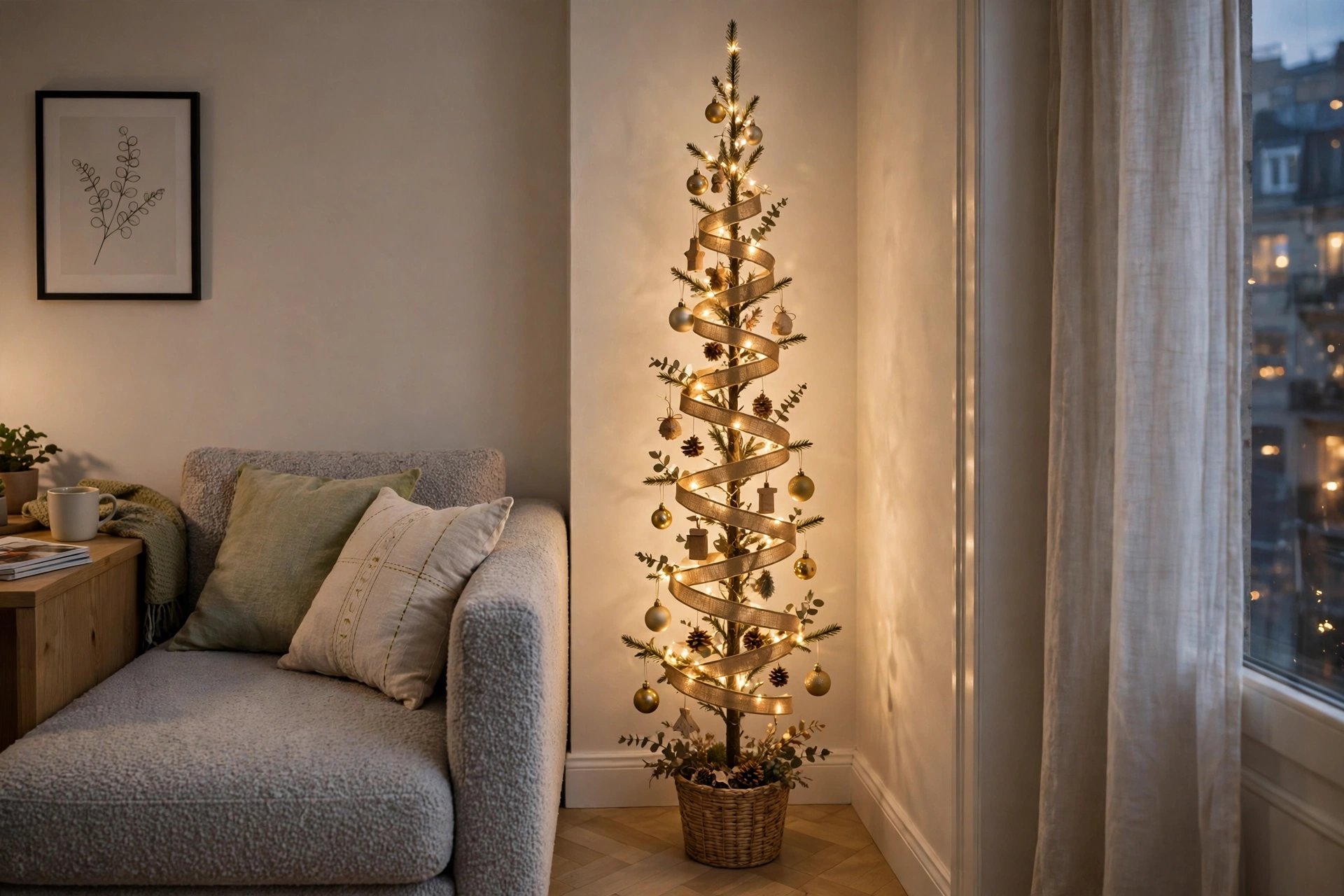
Start with a tape measure, not a shopping list. A slim pencil tree is usually 30 to 45 centimetres across at its widest point, which means it fits a hallway corner, the narrow wall beside the television, or the gap between a sofa and a bookcase. A tabletop tree, 45 to 60 centimetres tall, fits a sideboard, a console, or a sturdy stool. It works in a bedroom or a home office where a floor tree never would. A wall tree, made of lights or a flat wooden frame, uses no floor at all.
If your room is truly tight, choose the smaller tree and decorate it well rather than squeezing in a full tree and decorating it badly. A well dressed tabletop tree on a sideboard draws the eye the moment you walk in, while a cramped full tree with flattened branches on one side looks like an apology. The same thinking shapes our small Christmas living room ideas, where one slim tree in a corner does more than a large tree blocking the only walkway.
Before you buy, stand in the spot and check three things. Can two people pass without brushing the branches? Is there an outlet nearby, or will you need a battery pack? Can you still open the nearest door, drawer, or cupboard? If any answer is no, pick the next size down or move to a wall tree. A tree that fights the room will annoy you by the second week of December.
2. Lights First, and Count Them Before You Start
Lights always go on first, before ribbon, before garland, before a single ornament. That order matters, because lights tucked under ornaments look patchy, while ornaments hung over a finished web of light look like they belong. Fluff every branch first, pulling tips outward and upward, so the lights have something to sit on instead of sliding into gaps.
A useful guide is about 100 small lights per foot of tree height for a full look, and a little less for a slim tree, since slim branches hold fewer strands without looking tangled. For a five foot slim tree, 400 to 500 lights will glow nicely. For a two foot tabletop tree, one short strand of 50 to 100 lights is plenty, and battery lights with a timer save you from trailing a cable across the floor.
Warm white is the safest choice in a small room. Cool white can look sharp and a little blue, especially against warm wood and soft throws, and it makes a small room feel less cozy. Work from the trunk outward, weaving the strand in and out so some lights sit deep inside the branches and some sit near the tips. That depth is what makes a tree glow instead of just sparkling on the surface. Step back every few minutes and look for dark patches, because they are much easier to fix now than after the ornaments are on.
3. One Palette, Three Colours at Most
Small trees punish a scattered palette more than big trees do. On a large tree, twelve colours can read as joyful abundance. On a small tree, they read as clutter. Pick two main colours and one metal, and repeat that same combination in the rest of the room, on cushions, on a throw, or on the dining table, so the tree feels like part of the house rather than a separate event.
Classic red and gold never fails, and it suits warm wood and cream walls. Champagne gold and ivory looks calm and a little elegant, and it works beautifully on a flocked tree where the white branches act as a third colour on their own. Deep green, berry red, and warm brass give a traditional feeling without needing a single bright blue or pink ornament to wake it up.
Once you have the palette, be strict about it. When a well-meaning relative hands you an ornament in a fourth colour, hang it somewhere it can shine on its own, on a wreath or a door handle, rather than forcing it onto the tree. The tree will look designed, not accidental, and you will enjoy looking at it for the whole month. Our small Christmas kitchen ideas use the same discipline, one palette repeated on towels, wreaths, and the tray display, and the room feels calm because of it.
4. Ornaments in Layers: Deep, Middle, and Tips
The prettiest trees are not the ones with the most ornaments. They are the ones with ornaments at different depths. Start with your largest ornaments, and push them deep inside the branches, close to the trunk. They fill the dark middle of the tree, they catch light from the inner strands, and they stop the tree looking hollow from the side.
Next, hang medium ornaments on the middle branches, spaced so no two identical colours sit side by side. Step back often, because from the sofa you see the whole shape, not one branch at a time. Finally, add the smallest, lightest ornaments near the branch tips, where they catch the light and move slightly when someone walks past. On a slim tree, keep ornaments small, no bigger than about six centimetres, because a large bauble on a narrow branch makes the whole tree look lumpy.
Count roughly as you go. A good guide is 10 to 15 ornaments per foot of height, so a five foot slim tree needs about 50 to 75 ornaments, and a two foot tabletop tree needs only 15 to 25, all of them tiny. If you run out of ornaments, fill gaps with ribbon, picks, or small sprigs of greenery rather than buying a bag of random extras. A few bare patches of branch are fine, especially on a flocked tree, where the snowy branches are part of the look.
5. Ribbon and Garland Without the Bulk
Ribbon is the fastest way to make a small tree look finished, and the easiest way to make it look heavy. The trick is to use one ribbon, in one colour from your palette, and to run it in a loose spiral from top to bottom, tucking it into the branches every 30 centimetres or so. A wide ribbon, five to seven centimetres, works on a slim tree because it reads as a smooth line. A narrow ribbon disappears, and two ribbons fight each other.
If you love garland, choose a thin beaded garland or a short string of wooden beads instead of a thick tinsel rope. Beads add sparkle and texture without hiding the branches, and they are light enough not to drag a slim tree sideways. Skip heavy garland entirely on a tabletop tree, where one spiral of ribbon and a few sprigs of faux berries give the same finished feeling in a fraction of the bulk.
Tie the ribbon off at the top under the topper, and let the tail fall naturally rather than cutting it into stiff curls. When the ribbon follows the shape of the tree instead of fighting it, the eye travels upward, and the tree looks taller than it is. That upward line is the oldest small room trick there is, and it works on trees exactly as it works on curtains and shelves.
6. The Base Matters More Than the Skirt
A wide tree skirt is the enemy of a small room. It spreads across the floor, it trips people, and it eats the very walkway you were trying to protect. A basket, a tree collar, or a simple woven planter does the same job in a fraction of the space, and it looks more intentional. A slim tree in a tall basket reads as a piece of furniture, not a temporary visitor.
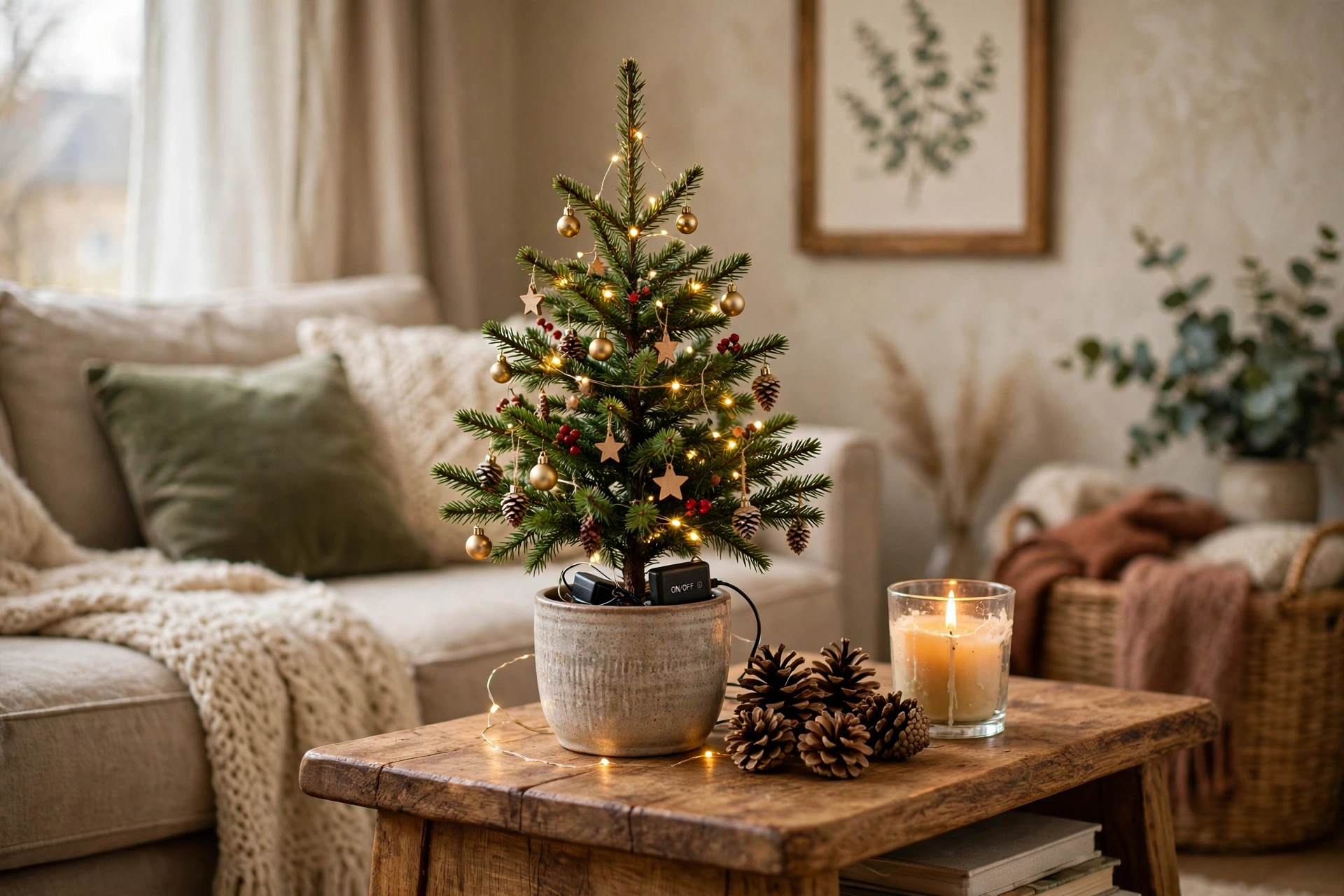
For a tabletop tree, the pot is half the decoration, so do not hide it. A ceramic pot, a galvanised bucket, or a woven basket with a folded blanket tucked around the base will do more for the display than any skirt. Make sure the pot is heavy enough that the tree cannot tip when a child or a pet brushes past, and put a small saucer or a folded cloth under it if the surface underneath marks easily.
Under a floor tree, keep the base tidy. Wrap the stand in a collar, or set the whole tree in a basket that hides the stand completely, and keep presents stacked to one side rather than spread in a wide ring. The room will feel bigger, the tree will look taller, and vacuuming in January will be a much smaller job.
7. Tabletop Trees Deserve Close Up Detail
A tabletop tree is seen from inches away, not from across the room, so it rewards detail that a floor tree would waste. Use mini ornaments, about two to three centimetres, tiny bows, and one or two special pieces, a miniature house, a tiny bird, or a handmade ornament, that guests will notice when they lean in. Keep the colours tight, because up close every stray colour shows.
Place the tree where it will be seen but not bumped, on a sideboard, a console, or a sturdy stool beside a chair, never on a narrow windowsill where it can fall, and never on a kitchen counter beside the stove. A group of three tabletop trees at different heights, on a sideboard or a mantel, makes a lovely display in a room with no floor space at all, and each tree can carry its own tiny theme as long as one ribbon colour ties them together.
Light a tabletop tree with battery fairy lights on a timer, so you never have to reach behind it to switch it on. One short strand, woven from the trunk outward, is enough. If the tree sits near a mirror, the reflection doubles the light, which is a free trick worth using in a small room.
8. When the Floor Is Full, Put the Tree on the Wall
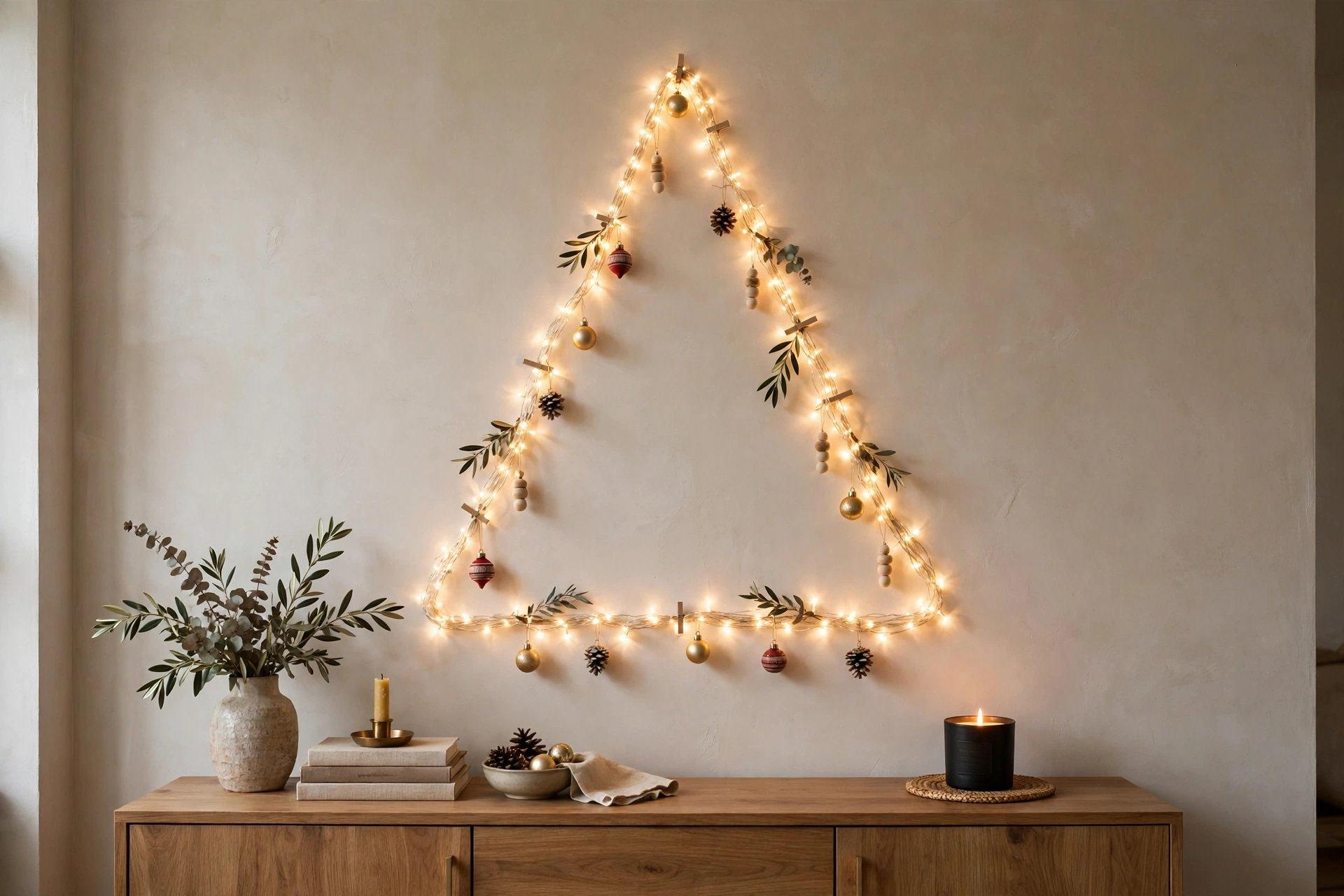
Some rooms genuinely have no floor left, and that is not a failure. A wall tree uses the one surface every room has in excess: the wall. The simplest version is a triangle of warm white string lights, fixed with small removable clips, starting wide at the bottom and narrowing to a star or a bow at the top. Add a few lightweight ornaments on the clips, and you have a tree shape that reads clearly from across the room.
A flat wooden frame tree, which folds out from the wall, gives you real branches to hang ornaments on without a stand at all. A felt tree, pinned flat to a wall, is a gentle option for a child’s room, where ornaments can be moved around all month without breaking. A garland tree, made by pinning a long evergreen garland in zigzag rows on the wall, smells wonderful and costs very little.
Whichever wall tree you choose, keep it to one wall, and keep the rest of that wall fairly plain, so the tree shape stays clear. A wall tree crowded in with frames, shelves, and a television stops reading as a tree and starts reading as clutter. Give it breathing room, and it will be the talking point of the room.
9. Keep Walkways, Heat, and Water in Mind
A beautiful tree that blocks a walkway, sits against a radiator, or drips on a rug is not a success. Keep at least a clear path to every door and to the main seating, even if that means choosing a slimmer tree than you first wanted. Keep real candles off the tree entirely, and keep fairy lights and battery candles well clear of curtains, dried garlands, and paper ornaments.
If you choose a real tree, water it every day, and check the stand before guests arrive. A dry tree sheds, it smells dusty, and it becomes a fire risk near lights. If you choose an artificial tree, fluff it over a sheet the day before decorating, let it settle overnight, and keep it away from heat vents, which dry out branches and fade ornaments. Either way, switch lights off when you leave the house or go to bed, or put them on a timer so you never have to remember.
The same care applies to the rest of the room. Our small Christmas dining room ideas keep the table centrepiece low so guests can see each other, and the same idea applies here: a tree should never block conversation, a television, or the view out of the window. When the tree sits comfortably in the room, the whole house feels easier to live in.
10. Take It Down in One Box, and Remember What Worked
January is part of decorating, not an afterthought. Take a photo of the finished tree before you start taking it down, so next year you remember which ribbon, which ornaments, and which base worked. Then pack by category, not by room: ornaments in one box, lights in another, ribbon rolled, not folded, so it does not crease.
Label the box with the palette and the tree size, and note anything you want to change, a shorter strand of lights, smaller ornaments, a heavier basket. A small tree and its decorations should fit in a single box, and if they do not, that is a useful sign that something on the tree was not earning its place. Next December, you will open one box, not search through five, and the tree will be up in an evening instead of a weekend.
A small space Christmas tree is not a compromise. It is a design choice, and when it is made well, it is the warmest corner of the house. Pick the tree that fits, light it warmly, keep one palette, decorate in layers, and give it a base that belongs in the room. Do those five things, and your tree will feel generous, not small, all season long.