
A Small Room Can Still Feel Like Christmas
A living room does not need a big tree, a dozen boxes of ornaments or a mantel that covers the entire wall to feel like Christmas. It needs one focal point, warm light in the right places and a few soft textures that make the room feel lived in rather than staged. When every decoration must earn its place, the room often looks better than a room that is filled without a plan. The trick is to choose less, choose it well, and repeat the same colors and materials in two or three places so that the entire room feels connected.
This guide is written for small rooms: apartments with one sofa wall, homes where the television shares a wall with the tree and living rooms where the coffee table is also the homework table, the snack table and the place where guests set down their mugs. You will find ideas that use walls, windows, shelves and furniture you already own so you do not need to buy a room to decorate the room you have. Start with the tree and the lights, then add textiles, then finish with one shelf and one table detail. If you stop after the five ideas, the room will already look finished.
Before you bring out a box, walk the room slowly. Notice where you walk every day, where the light falls in the evening and which wall your eyes land on first when you come in from the hallway. That first wall is the place for a focal point. Keep walkways clear, keep cords away from heaters and curtains and keep ornaments above the height where bags, coats and small hands tend to swing past. A calm room, with five touches, beats a crowded room with fifty rushed ones every time.
1. Pick One Focal Point and Let the Rest Stay Calm
Every small room needs one spot where the eye can stop and rest. In living rooms, that spot is the tree, the mantel or a single decorated shelf. Choose one of these to be the star. Build everything around it. If the tree is the focus, keep the mantel clean and simple, a garland and two candles. If the mantel is the center, go with a tabletop tree or a wall-mounted tree instead of a large floor tree. When two areas fight for attention, the room feels crowded even before you add anything else.
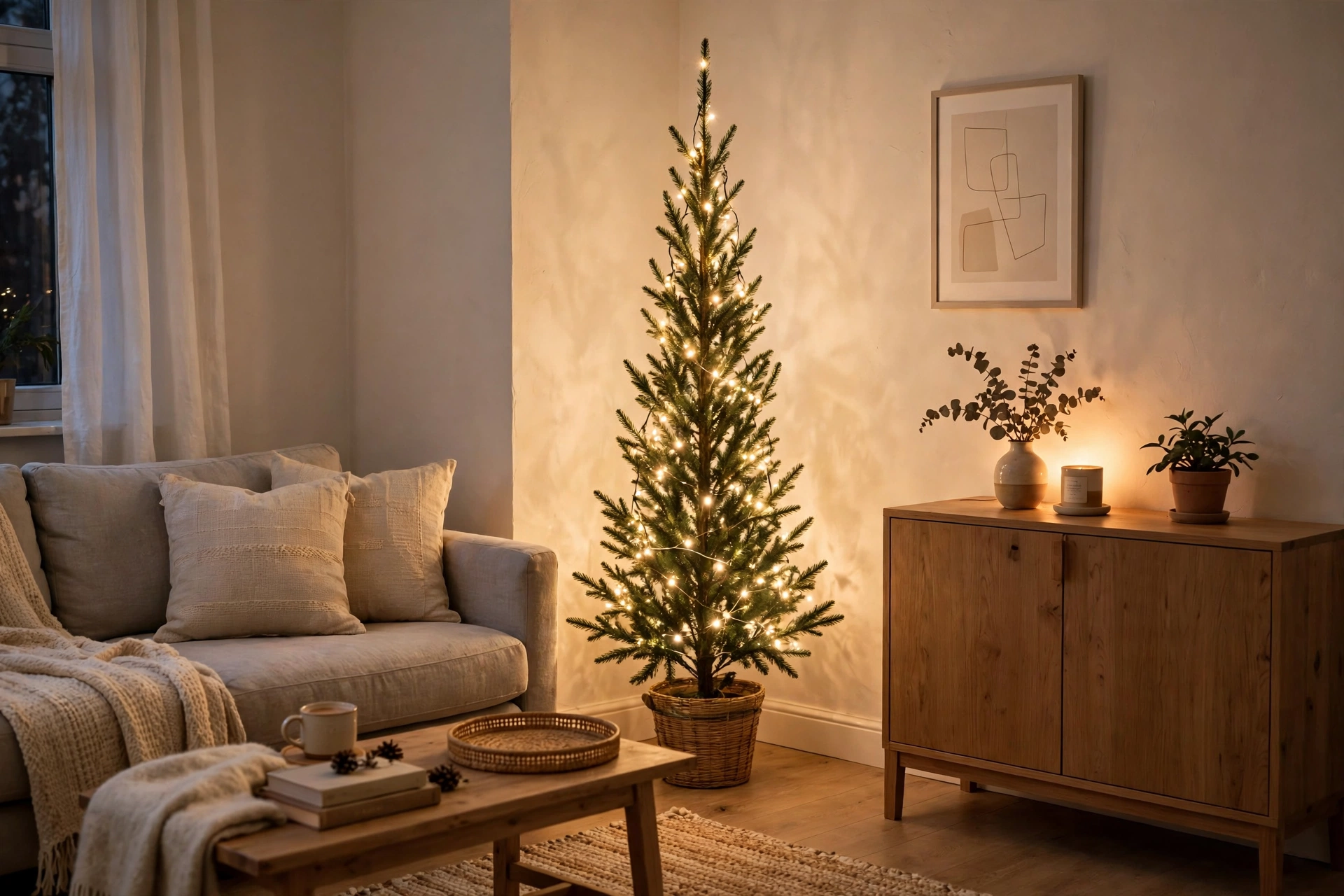
To make the focal point stand out, give it height, light and one consistent color. A slim tree with white lights pulls the eye upward, which makes the ceiling feel taller. A garland with the lights connects the mantel to the tree without introducing a new color. A basket at the base of the tree hides the stand and adds a natural texture that softens the look. Step back. Take a photo with your phone. If your eye jumps to three spots at once, take one item away from the most cluttered spot and try again.
A good way to test the design is the doorway test. Stand in the doorway. Count how many things catch your eye in order. If you see the tree first, then the lights, the cozy throw, you have a clear hierarchy. If you see clutter, tangled cords and five small objects all trying to be noticed, you need to simplify. Small rooms grow better with restraint. You can always add one thing tomorrow, but a room that starts calm is much easier to enjoy all season long.
2. Choose a Tree That Fits the Room, Not the Other Way Around
The tree sets the tone for the room, so it is worth picking the tree before you buy anything else. A slim pencil tree fits a tight corner and leaves room to walk past it, sit down, and open a door without a struggle. A flat back tree pushes flush against a wall, which is ideal when the only free wall is behind the sofa or beside the television. A tabletop tree on a side table, a console, or a sturdy shelf can look just as festive as a floor tree, and it costs less to decorate.
Measure first, then shop. Note the width of your corner, the depth available against the wall and the height of your ceiling. A tree that is too tall for the room will feel cramped at the top, while a tree that is too wide will eat the walking path. Keep the lowest branches clear of the sofa arm and the coffee table, so nobody brushes ornaments every time they sit down. If you have almost no floor space at all, shape garland into a simple tree outline on a blank wall and add a few light ornaments. It gives you the shape and the greenery of a tree, it takes up no floor space, and it comes down in minutes after the holidays.
Decorate a tree lightly. Fewer, larger ornaments read better than dozens of tiny ones that disappear into the branches. Repeat one or two colors from the rest of the room, add warm lights first, then ornaments, then one simple topper. Leave a little green showing between ornaments. That breathing room is what makes a small tree look intentional rather than overloaded, and it makes the lights glow more beautifully in the evening.
3. Use Warm Light as Your Main Decoration
Light does more for a small Christmas living room than any single ornament. Warm light, such as warm white string lights, battery candles, and one or two lamps with warm bulbs, can make a room feel festive before a single bauble goes up. Start with one line of lights in one place, such as the tree or the window, and add a second layer only where it will actually be seen in the evening. Overhead lights tend to flatten a room, while low, warm light makes it feel soft and inviting.
Try light behind sheer curtains to create a gentle glow across one wall. Drape a strand of warm lights along a mantel or a shelf, tuck a set into a glass jar on a side table, or wind lights around a garland on a console. Battery operated candles on the coffee table or the windowsill give you the flicker of candlelight without an open flame near throws and curtains. If you already have lamps, a warm amber bulb in a single accent lamp can shift the whole mood after dark without adding one new object to the room.
Keep cords safe. Run them behind furniture, keep them from heaters and walkways and use timers so warm lights turn off on their own at night. In a small room, one tangled cord can undo the calm of the whole display. When the lights are on and the overhead light is off, step back and look. If the room glows softly from two or three places, you have enough. You do not need light on every surface to feel the season.
4. Swap Textiles Instead of Adding Furniture
The quickest, cheapest and most storage-friendly way to refresh a small living room is to swap out textiles you already use. Change cushion covers to a festive color, fold a plaid or chunky knit throw over the sofa arm, and lay a simple runner on the coffee table or console. When the season ends, the covers fold flat, the throw goes back to the basket, and the room returns to normal without a single box to store.
Choose two colors. Use them in different ways. A classic combination is deep green with cream or red with warm gold. A calmer pairing is cream, soft gold, and natural wood, which suits rooms that already feel warm. Avoid bringing in a third and fourth color on every surface. In a small room, a tight color story is what makes the space feel curated instead of cluttered. If your sofa is a strong color, let the throws and cushions echo it rather than fight it.
Texture is just as important as color. Velvet cushion covers, a woven throw and a soft rug under the coffee table add warmth that photographs beautifully and feels good to live with. Keep one surface mostly clear, such as the side table where you actually set down a mug. A room that looks cozy in a photo but has nowhere to set a drink will feel frustrating by the second evening. Comfort is part of the decor, not separate from it.
5. Decorate Up, Not Out
I love decorating rooms when space is tight, so I go vertical. Walls, the tops of shelves, curtain rods, and the space above the television are all free real estate in a small room. Hang a wreath on a mirror so the reflection doubles the effect and makes the room feel larger. Hang lightweight ornaments from a shelf edge or a curtain rod for a whimsical touch that uses no table space at all. Use a picture ledge as a mini display for small trees, candles, and one framed holiday print.
A wall tree is one of the solutions for small rooms. I love decorating with a wall tree. I shape garland into a triangle on a blank wall, add warm lights and a few light ornaments, and you have a tree that takes up no floor at all. A flat felt tree works well in homes with small children or pets, since soft ornaments cannot break or be knocked down easily. A ladder leaned against a wall can hold stockings, a throw, and a strand of garland, and it works beautifully in rooms with no fireplace at all.
Be careful with weight and fixings, in rentals. Use hooks and strips rated for the weight you hang and keep heavier ornaments low. Test one hook before you hang a full garland. Vertical decorating should feel light and airy, not like the walls are closing in. Leave wall space between displays. That breathing room is what keeps a vertical display feeling intentional rather than crowded.
6. Style the Mantel, or Make One Where There Is None
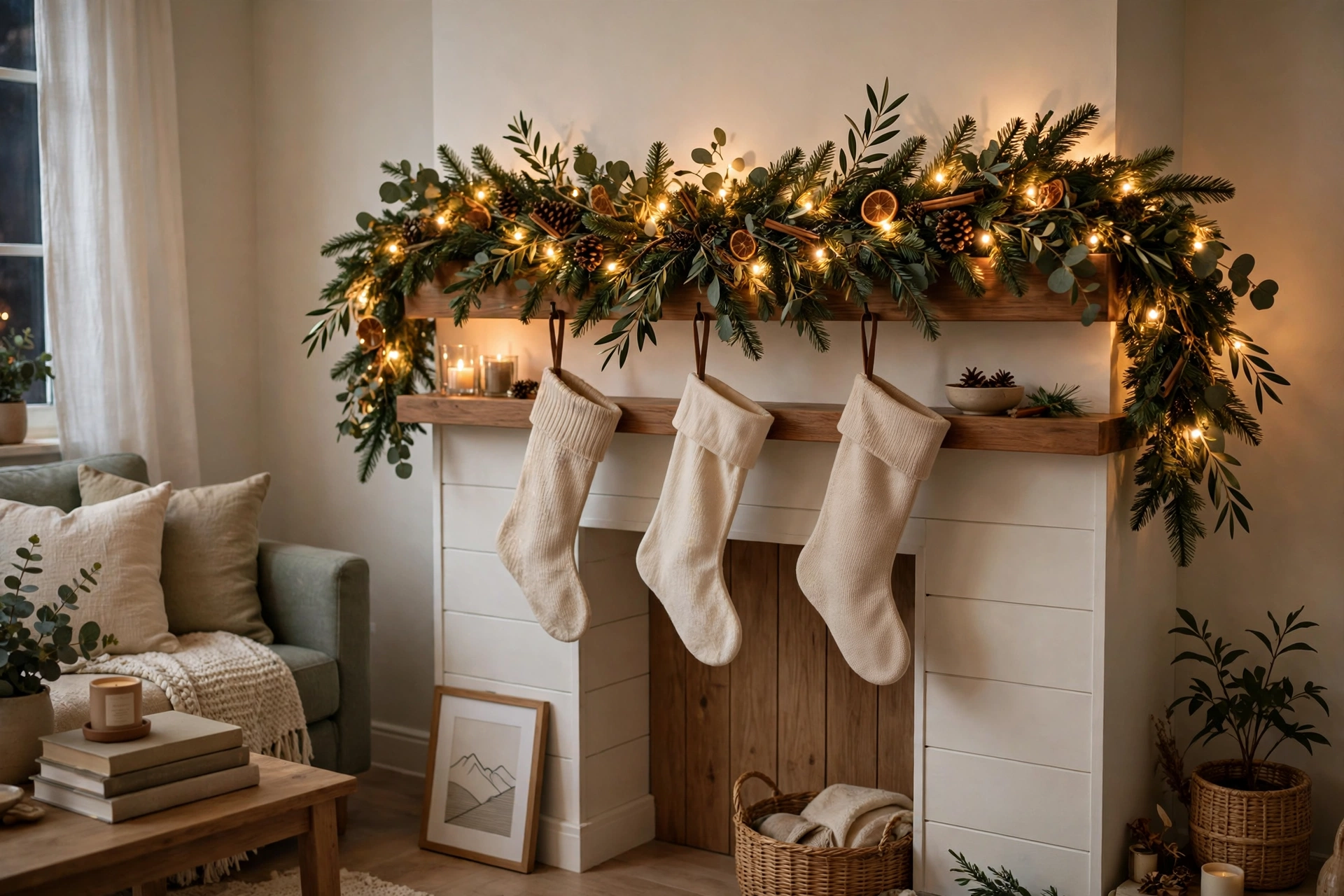
A mantel is a focal point, but many small living rooms do not have one. If you do have a mantel, keep it simple: one garland, warm lights, two or three candles at different heights, and stockings if you use them. Avoid lining the whole mantel with small objects at the same height. Vary the heights, leave gaps, and let the garland be the main line that ties it together. For more mantel ideas in a cozy living room, see our guide to Thanksgiving mantel decor ideas for a cozy living room.
If you do not have a mantel, make a mantel moment somewhere else. A console table, the top of a bookshelf or a windowsill can carry the same idea: greenery, light, and one or two meaningful objects. Hang stockings on a decorative ladder, on a shelf edge, or on removable hooks under a shelf. The feeling of a mantel comes from the grouping, not from the architecture. A small shelf with a garland, candles, and stockings reads as a mantel to everyone who walks in.
Keep the mantel display low enough that it does not block a mirror or artwork you love and high enough that candles are away from curtains and throws. Battery candles are a safe choice here, especially if the display sits near fabric. When the lights are low and the mantel glows, the whole room feels warmer, even if the rest of the decor is very simple.
7. Keep the Coffee Table Low, Clear, and Useful
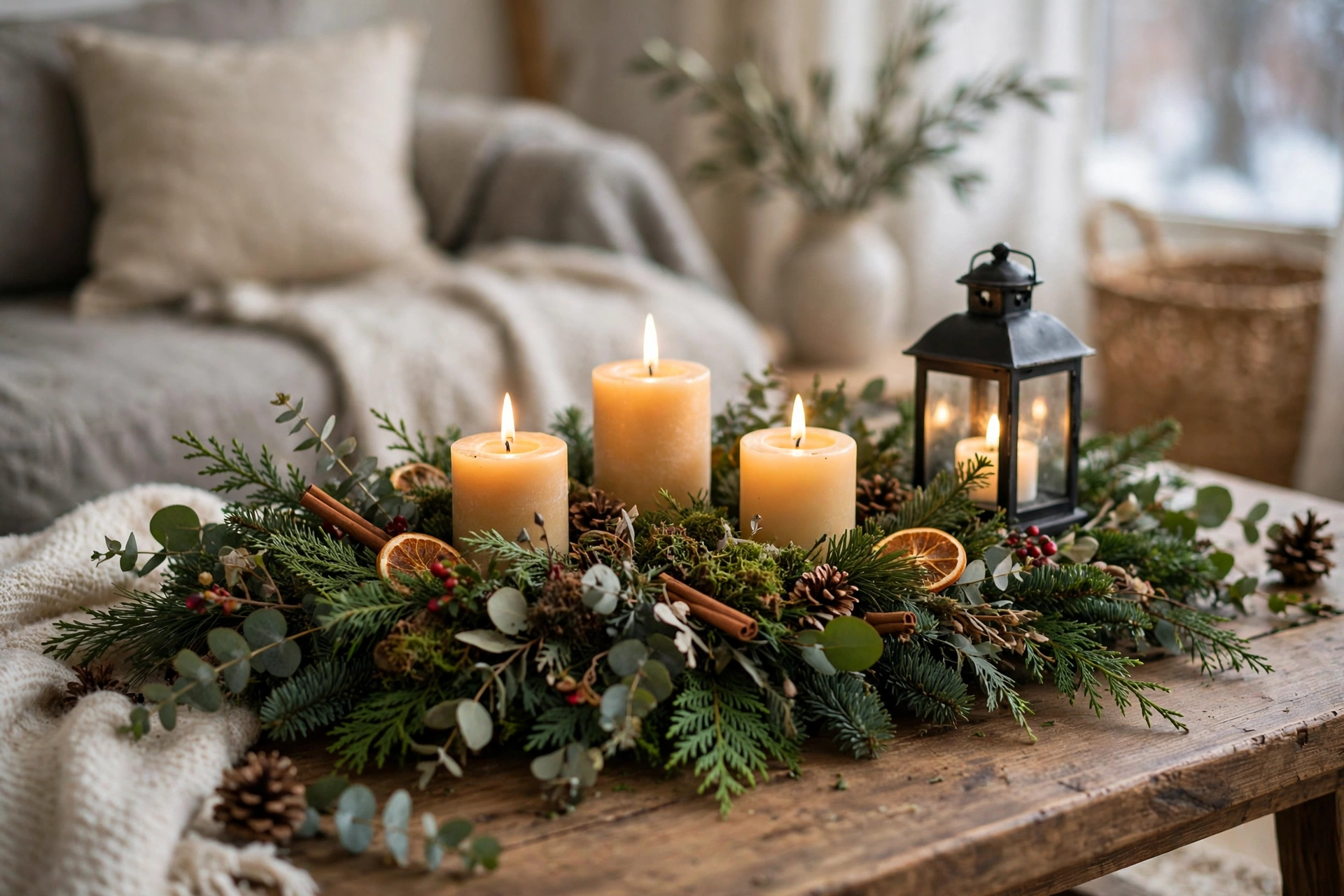
I like to think of the coffee table as the bridge between Christmas decorations and everyday life, so it must stay useful. I pick one centerpiece instead of many tall items that block conversation and get in the way of mugs and snacks. A tray is my friend here. It holds candles, greenery and a few ornaments in one display. I can lift the tray away when I need the table for a meal or a game night.
A simple formula works well for me. I use one tray, one candle or lantern, a bunch of greenery or pinecones and one low decorative object such as a ceramic tree or a small bowl of ornaments. I keep everything below eye level when seated, so guests can see each other across the table. I avoid fragile or easily toppled items if children or pets use the room. A low centerpiece that survives an evening is better than a tall one that must be moved out of the way each December.
I always leave room for life. A coaster, a mug and a small plate should still fit comfortably. If my centerpiece takes up the table, it is too big. I scale it down by one item. Try again.
The best Christmas coffee table looks festive in a photo and still works when friends come over with hot drinks and a board game.
8. Dress the Window Without Blocking the Light
Windows are a gift in a room because they add decor without taking any floor or table space. Frame a window with fairy lights, hang a wreath in the center or place battery candles along the sill. From outside, the window glows like a sign. Inside, it turns the room into a cozy nook, especially when the curtains are drawn back in the evening.
Keep the window treatment light. Sheer curtains soften string lights beautifully. They still let daylight in during the day. Heavy, dark curtains plus a full window display can make a small room feel closed in. If you use window clings, choose snowflakes or stars rather than a busy scene that blocks the view. One wreath per window is plenty. Two windows can share the style, which ties the room together without extra shopping.
Check that lights and candles near a window stay away from curtains and blinds and that cords do not cross a walking path to reach an outlet. Battery lights solve window problems since they need no outlet at all. In the evening, with the light off and the window glowing, even a very small room can feel like the coziest place in the house.
9. Use Baskets, Trays, and Storage That Doubles as Decor
I love how small rooms need storage. Christmas is a time to let storage do double duty. A woven basket under the tree hides the stand and holds extra throws. A basket by the sofa holds blankets for evenings and looks intentional rather than messy. A basket in the entryway, which we explored in our Christmas entryway decor ideas for a small space, keeps winter gear tidy and carries the festive feeling from the door into the living room.
Use trays on tables, boxes on shelves and lidded baskets under consoles to hide clutter that competes with decor. When remotes, chargers and magazines have a home, Christmas touches stand out clearly. Choose natural materials such as wood, woven seagrass and cotton. These soften the sparkle of ornaments and lights and keep the room feeling warm rather than glittery.
Think about January, too. The best Christmas storage is storage you will still use after the tree comes down. A basket that holds throws in December can hold magazines in February. A tray that holds candles in December can hold a plant in spring. Buying decor that keeps working is one of the things you can do for a small room and for your budget.
10. A Simple One Evening Plan, Plus Renter Friendly Tips
You do not need a whole weekend to decorate a small living room. Start in the evening, when you can see the lights properly. First, clear one surface and put away anything that does not belong in the room. Second, place the tree or wall tree and add lights. Third, swap cushion covers and add the throw. Fourth, style the mantel or shelf and the coffee table tray. Fifth, add the window detail and step back for a photo. If the photo looks calm and warm, you are done. If one spot looks busy, remove one item from that spot only.
Renters can do almost all of this without drilling a single hole. Removable hooks, strips and tension rods hold garlands, wreaths and lights safely. Lean a ladder or a large frame against a wall instead of hanging it. Use tabletop and shelf displays instead of wall mounted ones where the lease is strict. Always test a removable strip in a hidden spot first and check the weight rating before hanging garland. When you move out, the room should look exactly as it did before, with no marks left behind.
Safety matters in a small room because everything sits closer together. Keep real candles away from greenery, throws and curtains, or use flameless candles instead. Keep cords away from heaters and walkways, keep small ornaments and batteries away from children and pets, and keep exits and walking routes clear. A festive room that is also safe is a room you can relax in all season long.
Frequently Asked Questions
How do I decorate a small living room for Christmas without clutter?
Choose one spot in the room to be the center of attention. Stick to one color theme using two or three colors only. Instead of adding furniture, change out the textiles like throws, pillows and curtains. Keep one surface clean and free of items. Make sure people can walk through the room easily. When you think you are done, take a photo. If the picture looks too full, take one item away from the crowded area.
What size tree works best in a small living room?
A slim pencil tree, a flat-back tree that fits against the wall or a tabletop tree on a piece of furniture often works best. Measure the corner and the ceiling height. Keep the walkway clear and make sure the branches do not hang over the sofa arm or coffee table. If there is no floor space, a garland wall tree can be a beautiful and space-saving choice.
Can I have a cozy Christmas living room on a small budget?
Yes, you can. Start with what you have: candles, baskets, ribbons, jars and throws. Change the cushion covers, add one string of lights and style one shelf and one table tray. Buy one item that will make a big difference, like warm lights or cushion covers you can use again next year, and store them flat after the holidays.
Final Thoughts: Less, Warmer, More Yours
A small Christmas living room is best when it feels like your room and it feels warmer. You do not have to copy a showroom or buy everything in one trip. Choose a tree that fits, light it with warmth, swap a few textiles, decorate upward and keep the coffee table useful. Leave space to sit, to talk, to set down a mug and to enjoy the people who come through the door. That is what makes a room feel like Christmas, long after the lights are turned on.
Start tonight with the lights and the throw. Add the tree tomorrow. Add the mantel the next evening. Decorate in stages. Stop when the room feels calm and happy rather than finished in a magazine way. Your small living room, decorated with care and a little restraint, will glow beautifully all season. It will be easy to love living in, not just looking at.
Pingback: Christmas Tree Decorating Ideas for a Small Space